
Use case, aviation
Airport screen networks
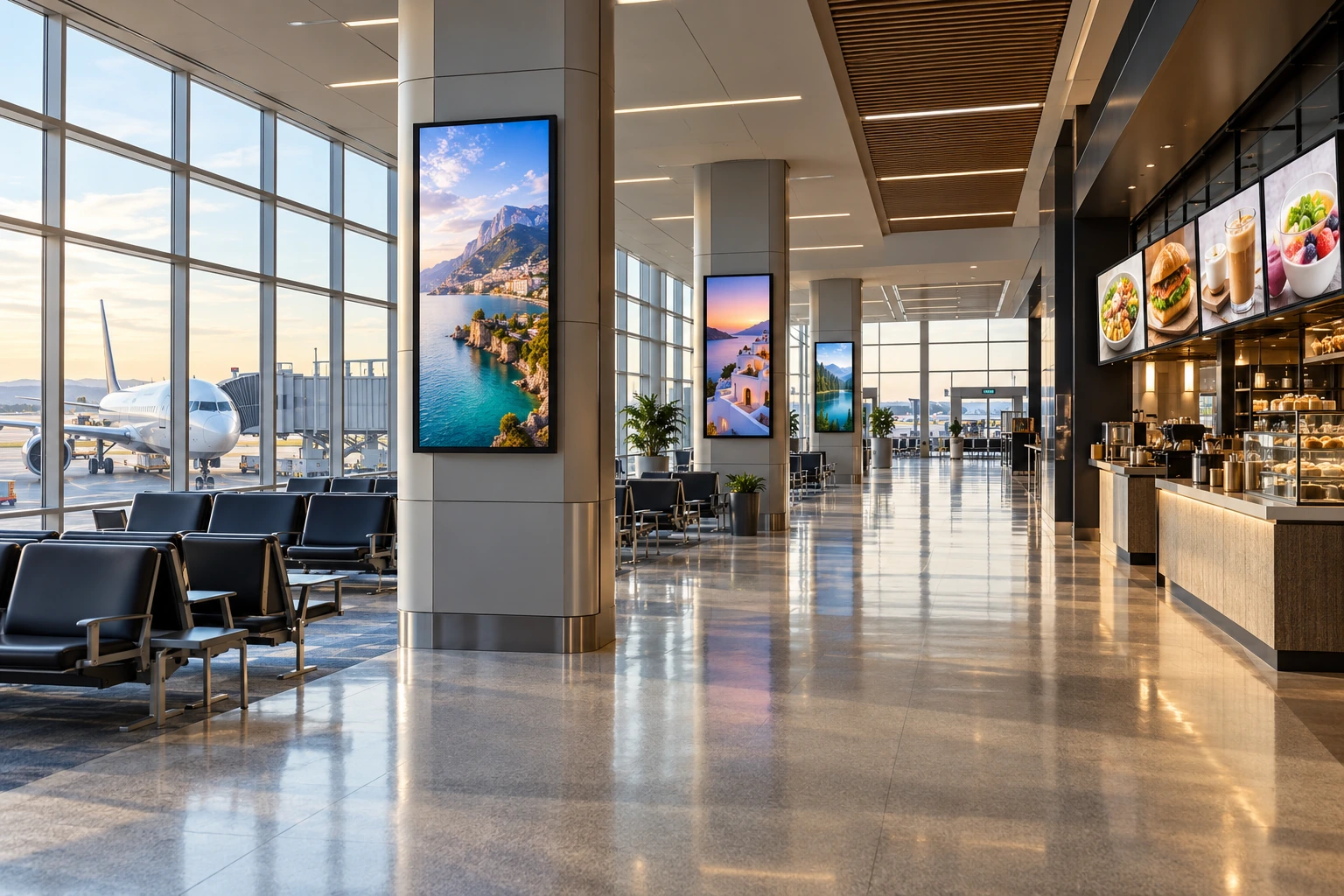
Adverro runs a concession advertising network of 100 screens across T1, T2 and T3 at Indira Gandhi International Airport, Delhi, live since July 2026. The same platform can carry flight and gate information from your own systems, on the panels already in the building.
Every play is recorded for campaign reconciliation, screens are named by terminal and position, and access groups keep each concession team to its own zone.
Live
Three terminals, one platform.
Airport | Indira Gandhi International Airport, Delhi |
Operation | Aviation, build-own-operate-transfer (BOOT) concession |
Terminals | T1, T2 and T3 |
Screens | 100 |
Panel platforms | Samsung Tizen 6.0 and above, and Android 12 and above |
Media players | None. The application runs on each panel’s own chip. |
Live since | July 2026 |
Advertising and concessions
The record an advertiser will accept.
A trace for every play
Every play of every asset on every screen is recorded: which asset, which screen, when. It is the record a concession reconciles campaigns against. Reports are emailed on request as CSV, XLSX or PDF, and real-time proof of play is available as a paid add-on.
Named the way the terminal speaks
At Delhi, screens are named by terminal and physical position, down to individual standee numbers at named outlets and gates. Utilisation is reported per terminal and content performance per asset, so a duty manager and the dashboard use the same words.
Access by zone
Access groups make devices and folders private to a group of users, so a concession team works on its own zone of a terminal without seeing, or changing, the rest.
Approval before it plays
A Content Manager’s upload can be routed to a Client Admin for approval before it is published, which is where a brand check or an airport sign-off sits.
Flight and gate information
Your operational data, on the terminal's screens.
Flight and gate data reaches a screen in one of two ways. A web view zone shows the page your operational system already publishes, a departures board for example, and updates with it. Or values are pulled from an API into an HTML template as variables, so the layout is Adverro’s and the data is yours.
There is no shipped connector for a specific flight information or airport operational database product. Integration is through a web view or API variables, so the question to settle early is which version of your system you are integrating and who maintains it when that system is upgraded.
If the source stops responding, the screen holds the last value it received rather than blanking the zone. A configurable refresh interval makes the screen pull again once it elapses, which bounds how stale a value can get.
Operating a terminal estate
What running it every day involves.
A network fault is not a dark board
Playback runs from a cache on each panel for as long as its licence token remains valid, and scheduled changes still happen on time if their content was downloaded before the connection went. The screen resynchronises on its own when the connection returns.
Faults from the dashboard, not the phone
A screen counts as offline after five minutes without a playback trace, and offline alerts go to the admins you choose once a threshold you set has passed.
A change applies to a terminal
Screens are tagged by terminal and zone, so a playlist published to a tag reaches every screen carrying it, rather than screen by screen.
A daily restart
Screens have run continuously for several weeks in testing without stability issues, and we still schedule a restart once a day per screen. It keeps the runtime clean on an estate nobody is standing next to.
Hardware in a terminal
Whatever is on the wall today.
Commercial panels
Samsung Tizen 6.0+, LG webOS 6.0+ and Android 10+ panels run Adverro on their own chip, so nothing is mounted behind a standee or a gate screen.
Video walls
A wall runs through one Windows PC that drives every panel in it, registered and licensed as one device, and synchronised by default.
LED walls
The Adverro player connects over HDMI to the wall’s LED processor, such as a Novastar or Colorlight controller.
Everything else
A display that cannot run Adverro on its own chip gets a compact Adverro Android or Windows player, managed from the same platform.
Running a terminal estate?
Talk to a product specialist about multi-terminal deployment, concession access and proof-of-play reporting for advertisers.